
The AI Doesn't Know You Exist
How AI decides who to recommend and why you're probably not on the list

Hey there! 👋
You're reading Open Scout 👀
Ask Perplexity what the best CRM is for a 20-person startup. The answer doesn’t come from a ranked list of websites optimized for that keyword. It gets synthesized from G2 reviews, Reddit threads, Hacker News comments, practitioner blog posts, and news articles. If the consensus across all those sources is that your product is mediocre, no amount of SEO will make the AI recommend you. And if the consensus is that you’re great, you might get cited without having done any optimization at all.
That’s a fundamentally different discovery system from the one we’ve had for twenty years. In Google’s world, being findable and being good were two separate skills. You could have a mediocre product and rank #1 through backlinks, keyword optimization, and domain authority. The gap between findability and quality was the defining feature of internet marketing. SEO exploited it. Ads bridged it. Content marketing papered over it.
AI is closing that gap. Which means the old winners don’t automatically stay on top.
Before we begin... a big thank you to this week’s sponsor: Attio

Your best growth lever is your CRM. That’s Attio.
It runs your revenue work, exactly as you want. Get hundreds of agents working on every account: run customer discovery, analyze conversion, and handle the work that used to take your team days.
Whether you’re working in your browser, inbox, or favourite agent, access your customer data in real time through Attio’s web app, MCP, API, and SDK.
Every signal turns into the context you need to move fast and scale without breaking.
See why 30,000+ of the fastest-growing teams build on Attio.
If you’re interested in sponsoring this newsletter, please reach out here.
Three eras
Every information system follows the same arc: starts honest, gets gamed, gets replaced by something harder to game. The internet’s discovery layer has done this three times.
→ Era 1: The Directory (1995-2003). Yahoo, DMOZ, Yellow Pages online. Discovery rewarded being listed. Show up and you’re findable. Honest but limited. Low barrier.
→ Era 2: The Algorithm (2003-2024). Google. Discovery rewarded being optimized. Backlinks, keywords, domain authority, content volume. Being findable and being good were COMPLETELY decoupled. A mediocre product with great SEO could outrank a great product with terrible SEO. Google knew this was a problem. It’s why they made so much from ads, because organic results weren’t trustworthy enough and companies had to pay to bridge the gap.
→ Era 3: The Synthesis (2024+). LLMs. ChatGPT, Perplexity, Claude, Gemini. Discovery rewards being respected. The model synthesizes reputation from Reddit threads, G2 reviews, Hacker News discussions, news articles, Wikipedia, practitioner blogs, community forums. You can’t game aggregate reputation the way you could game an algorithm. Being findable and being good are coupling for the first time in internet history.
Every era transition created a window where small players beat incumbents who were still playing the old game. Google Adwords in 2003. Facebook targeting in 2013. AI citations in 2025. The window is open now. It won’t stay open.
Why this shift is structural, not tactical
The standard take is “SEO is dying, learn GEO.” That’s wrong. What’s happening is bigger than a channel shift.
McKinsey’s AI Discovery Survey found that a brand’s own website accounts for only 5-10% of what AI search platforms reference. The other 90% comes from publishers, user-generated content, affiliate sites, and review platforms. Ninety percent. Your website might be perfectly optimized and it barely matters because the AI is forming its opinion of you from what everyone ELSE says about you.
That’s a complete inversion of content marketing strategy, which for twenty years has been about what YOU publish on YOUR site. In the AI era, your off-site reputation IS your discoverability. What users write about you on Reddit, what reviewers say on G2 and Capterra, what practitioners post on LinkedIn, what journalists mention in articles. 85% of brand mentions in AI responses originate from third-party pages, not owned domains. 48% of citations come from community platforms like Reddit and YouTube.
SEO teams always deprioritized these channels because they didn’t produce backlinks. Now they produce something more valuable: the community signal that LLMs synthesize into recommendations.
Even Google is starting to look more like an AI answer engine than a search engine. 48% of Google queries now trigger AI Overviews. When an AI Overview appears, users click traditional organic results only 8% of the time (Pew Research). The average AI Overview now exceeds 1,200 pixels in height and the standard desktop viewport is 900. The first traditional result doesn’t appear until you scroll past the AI answer. If you “rank” on Google but aren’t cited in the AI Overview, the user may never see your listing.
Users trust the AI summary because it feels like advice from a knowledgeable source, not a ranked list of websites competing for their click. That’s behavioral, not algorithmic. Harder to reverse.
How the synthesis engine works
Two mechanisms. Understanding which one you’re optimizing for changes everything.
→ Parametric memory. What the model absorbed during training. Roughly 60% of ChatGPT responses come from this without any web search triggered. Wikipedia is about 22% of LLM training data. Reddit, LinkedIn, YouTube are among the most-cited sources.
You can’t optimize for parametric memory in real time. If you weren’t discussed across these sources during the training window, you don’t exist for 60% of queries. No content optimization NOW changes what the model already learned. Getting into parametric memory is a long game: earned media, community presence, expert reputation. Brand, not SEO.
→ Retrieval. When the model searches live, it pulls from current sources. This is closer to traditional search but the signals are different. A study of 7,000+ citations found brand search volume is the strongest predictor of LLM citations (0.334 correlation). Backlinks showed weak or neutral correlation. The Princeton GEO study (10,000 queries, KDD 2024) found adding statistics increased visibility by 32%, expert quotations by 41%, and authoritative citations by 30%. LLMs cite only 2-7 domains per response. Fewer slots than Google’s 10 blue links. Higher bar. But selection favors substance over scale.
Two mechanisms, two strategies. Most teams only think about retrieval and are invisible for the majority of AI answers.
The 2x2
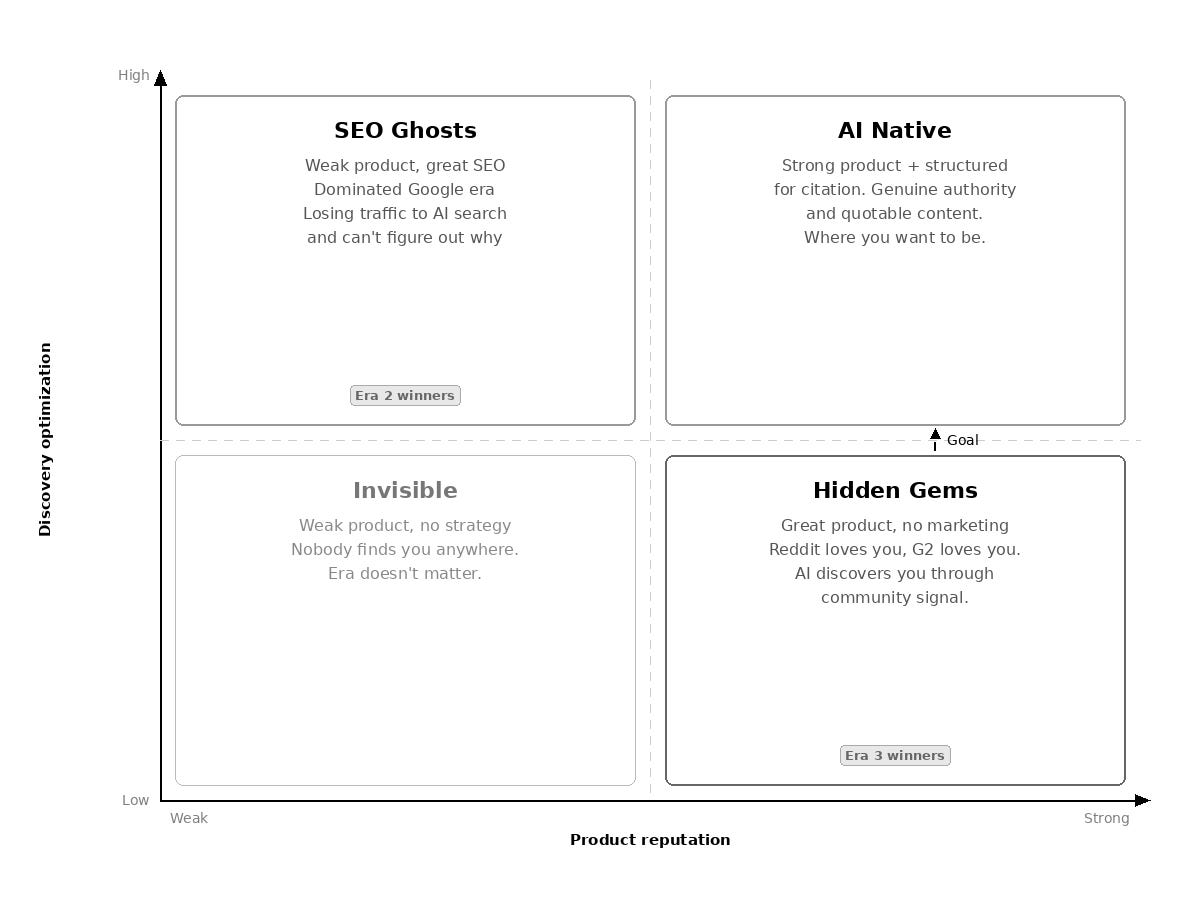
Think about companies on two axes: product reputation (how real users regard you) and discovery optimization (how sophisticated your findability strategy is).
Weak reputation, low optimization: Invisible. Nobody finds you anywhere.
Weak reputation, high optimization: SEO Ghosts. Dominated era 2. Rank on Google through accumulated domain authority and years of content. Product is fine, not great. In era 3, they’re in trouble. An LLM synthesizing from Reddit, G2, and practitioner forums surfaces the mediocrity that Google’s algorithm couldn’t see. These companies will lose traffic, won’t understand why, and will spend more on SEO trying to fix a problem that ISN’T an SEO problem.
Strong reputation, low optimization: Hidden Gems. Great product. Real users love it. Active Reddit discussions. Strong G2 reviews. Practitioners recommend it in Slack channels. But terrible at marketing. No content strategy. In era 2, invisible because Google couldn’t see community reputation. In era 3, the surprise winners. AI discovery reads the same signals actual humans use to evaluate products. The Princeton study found lower-ranked Google sites benefit MORE from GEO optimization than top-ranked ones. Hidden Gems start getting cited by LLMs without a growth team because the model found them through community consensus.
Vercel is a good example. ChatGPT now drives 10% of new signups. Not because Vercel mastered GEO, but because developers genuinely like it. The conversations that built trust across Reddit, Hacker News, and X are now feeding the AI systems people turn to for recommendations.
Strong reputation, high optimization: AI Native. Genuine quality AND content structured to be cited. This is where you want to be. The path from Hidden Gem to AI Native is mostly structural: take the reputation you’ve already earned and make it quotable.
The amplification effect
Andrew Chen at a16z wrote what might be the most useful essay in growth marketing: The Law of Shitty Clickthroughs. The first banner ad in 1994 had a 78% clickthrough rate. By 2011, Facebook ads averaged 0.05%. That’s a 1,500x decline. His observation: every marketing channel degrades over time because customers respond to novelty, first-mover advantage never lasts, and more scale means less qualified users. The conclusion: growth teams have to continually find the “fresh powder,” the next underexploited channel before everyone else arrives.
AI citations are the fresh powder right now. And the window math is specific. Brands cited in AI Overviews earn 35% more organic clicks and 91% more paid clicks than brands left out (Seer Interactive, 25.1 million impressions, 42 organizations). Being in the AI answer amplifies EVERY other channel because the AI acts as a validator. Your Google ads convert better because the user already saw the AI recommend you. Your organic listings get more clicks because the AI endorsed your credibility. Your outbound emails get opened because the prospect Perplexity’d you before the meeting and your brand came up.
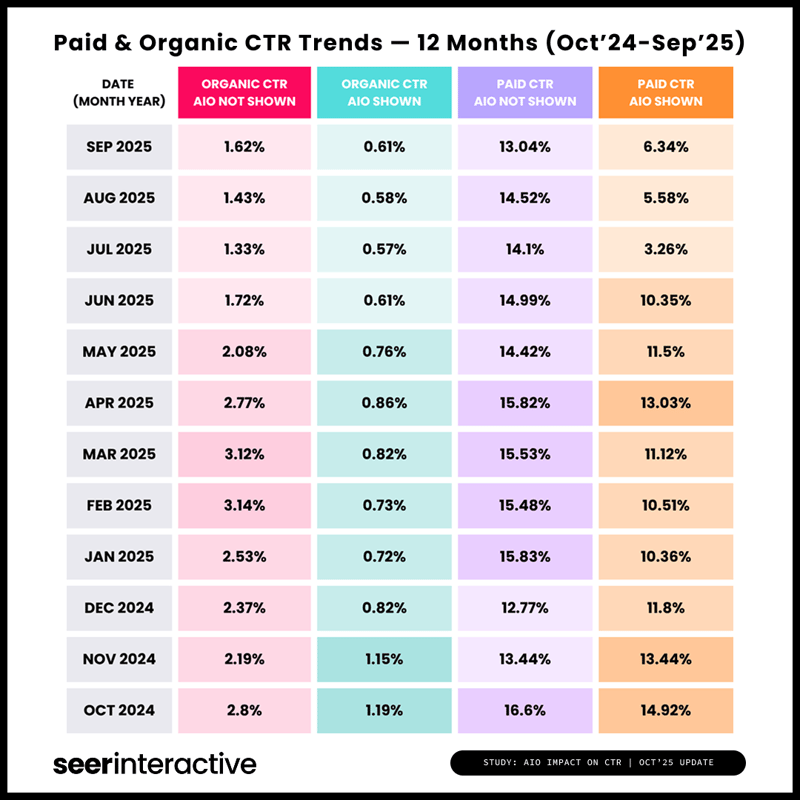
The inverse is the part most people miss. If you’re NOT in the AI answer, every channel works harder. The user saw recommendations and you weren’t among them. That absence isn’t neutral. It’s the 2026 version of not being on Google’s first page, except worse, because users trust AI curation more than they ever trusted Google’s ranking. Google felt like a list of options. AI feels like advice.
AI citations are working well for early adopters today. As more companies invest in the channel, those advantages will likely become harder to find.
Stock vs flow
SEO rankings were a stock metric. You invested in content, earned backlinks, climbed the rankings, and the position held. A page at position #3 in January was probably still there in June. The investment compounded. Budget it annually, check it quarterly, adjust it rarely. Growth teams loved this because the ROI model was clear: spend X, rank in Y months, earn Z traffic for years.
AI visibility is a flow metric. The model is non-deterministic. Same question five times, five different answers. There IS no “position #1.” You’re cited in response 1, absent in response 2, back in response 3. Pages not updated quarterly are 3x more likely to lose citations. New competitors publish. Community conversations shift. The model’s source pool changes with every retrieval.
This has real implications for how you invest. Stock investments have clear ROI timelines and you can model them in a spreadsheet. Flow investments don’t. AI visibility requires the kind of continuous presence that looks more like tending a garden than building a wall. You plant, water, weed, replant. The output varies by season. Stop tending and the garden dies faster than a Google ranking ever would.
Most growth organizations are built for stock metrics. Quarterly content calendars. Annual SEO audits. Campaign-based thinking. AI visibility requires a different operating rhythm: weekly monitoring across platforms, continuous publishing of fresh content, ongoing presence in community conversations, and an acceptance that the numbers will fluctuate in ways that SEO numbers never did. The team that does this well probably looks more like a community/PR function than a content marketing function, which is uncomfortable for organizations where content and SEO own the discovery budget.
And the measurement stack has to change with it. SEO had keyword rankings, organic traffic, domain authority, backlinks. Clean, mature, well-tooled. AI visibility needs a different set and most teams haven’t adopted any of them yet:
Citation frequency. Not rank. Frequency. What percentage of relevant prompts in your category mention you? Run the top 30 prompts your customers would ask across ChatGPT, Perplexity, Claude, Gemini. Document who gets cited, from what source, how they’re framed. Do this monthly. The trend matters more than any single snapshot because of the 30% stability problem.
Share of voice. Your citations versus competitors’ across those same prompts. In SEO you tracked keyword rankings against competitors. The AI equivalent is: when someone asks “what’s the best [your category],” how often do you appear vs the other three names that show up?
Sentiment in citation. Being mentioned isn’t enough. HOW you’re framed matters as much as whether you’re cited. “Popular but has reliability issues” is actively worse than not appearing at all. The model doesn’t just mention brands. It characterizes them. If G2 reviews skew negative or Reddit threads complain about your onboarding, that sentiment shows up in the AI’s framing of you.
Cross-platform divergence. Only 11% of domains get cited by both ChatGPT and Perplexity. You might be highly visible on one and completely absent from another. Each platform has different source preferences, different retrieval logic, different training data. Single-platform tracking is flying blind.
The tooling for this is maturing fast. Profound tracks brand visibility across 10+ AI engines. Ahrefs Brand Radar monitors citations across ChatGPT, Perplexity, Gemini, Copilot, and Claude. Semrush added AI visibility to their existing suite. Peec AI and Otterly.ai are doing the same at smaller scale. A year and a half ago none of these existed. The measurement layer is forming in real time, which is both a problem (nothing is standardized yet) and an opportunity.
What “building brand for AI” actually looks like
The practical section. Because frameworks without actions are just observations.
Reddit, specifically. Not “be on Reddit.” Which subreddits do your target customers use? For B2B SaaS, r/SaaS, r/startups, r/Entrepreneur, and the category-specific sub. For dev tools, r/webdev, r/programming, the language-specific subs. The approach: answer real questions with genuine depth. Don’t drop product links. Be the person who gives the most helpful answer in the thread. Over time, your profile becomes associated with expertise in that domain. The model reads these threads. When a user asks ChatGPT about your category, the helpful Reddit contributor who happens to work at your company is one of the signals the model synthesizes.
G2/Capterra review campaigns. Treat this with the same rigor you treat backlink building. After every successful onboarding, ask for a review. After every positive support interaction, ask for a review. After every quarterly business review where the customer reports ROI, ask for a review. The volume and sentiment of these reviews directly influence how AI characterizes your brand. A company with 400 G2 reviews averaging 4.6 stars gets cited differently than a company with 12 reviews averaging 4.0.
Original research. If you have proprietary data, publish it. Benchmarks, surveys, analyses. The Princeton GEO study found that content with statistics gets 32% more AI visibility and content with authoritative citations gets 30% more. If you publish something nobody else has, a benchmark study, a dataset, a framework, AI engines have a reason to cite you over a dozen lookalike competitors.
Structure owned content for citation. Stop writing 2,000-word SEO articles that bury the answer under context. Lead with the answer (bottom-line up front). Include specific statistics with sources. Name entities explicitly. Add FAQ blocks and comparison tables. The mental model: write to be the source an LLM wants to quote, not the page Google wants to rank.
The window
Gartner projects traditional search volume will decline 25% by 2026 and organic traffic will drop 50% by 2028. AI referral traffic grew 357% year over year to 1.1 billion visits. 71% of Americans use AI search for purchase research.
The traffic is migrating. Most growth teams aren’t.
Every channel degrades as it gets crowded. SEO did. Facebook ads did. AI citations will too. But right now the playbook isn’t codified, the tools aren’t mature, the measurement layer is still forming, and most incumbents are still allocating the majority of resources to Google. That’s the same environment that made early Adwords and early Facebook targeting so valuable. The companies that moved first owned their categories before the competition arrived.
For startups this window matters even more. In SEO, competing against an incumbent with 15 years of domain authority was nearly impossible. In AI discovery, smaller sites benefit more from GEO optimization than large ones. Specificity beats scale. A niche brand with deep expertise, well-cited content, and genuine community discussion can get cited alongside or instead of a giant incumbent whose content is broad and generic.
The playing field isn’t level. But it’s more level than it’s been since 2003. And like every era transition, the companies that recognize the shift while the old guard is still playing the old game will disproportionately benefit.
For twenty years, growth teams optimized for a system that rewarded being findable. The new system rewards being good. That’s not a channel change. That’s an era change. And the gap between the companies that see it and the ones that don’t is going to be enormous.
Thanks for reading.
If you enjoyed this issue, send it to a friend—it helps more than you think.
Back in your inbox Thursday,
Do you see the "every marketing channel degrades over time because customers respond to novelty" argument happening to AI already? (i.e. the DuckDuckGo +30% week on week spike in traffic)
The 'Hidden Gem' framing is accurate but the problem compounds at SKU level in ecommerce: a brand can have genuine community love for their hero products and still be invisible in AI for 80% of their catalog because long-tail SKUs have zero Reddit presence, zero reviews, and nothing for the model to synthesize. Are you seeing evidence that brand-level reputation lifts the whole catalog in transactional queries, or does the model evaluate each product independently when the intent is bottom-of-funnel?