
The Zombie Problem
The most common outcome in venture isn't failure or success. It's neither.

Hi 👋,
You're reading Open Scout 👀
Failure has a funeral. You raise money, you run out, you send the sad email, everyone moves on. It’s clean. Painful, but clean.
The zombie startup gets no funeral. It just keeps breathing. Payroll runs. Customers renew. The dashboard blinks green. And somewhere in a quiet moment the founder realizes the company will never grow enough to win or sell for enough to matter, but it also won’t die, so it just continues, year after year, consuming the most valuable years of everyone’s career.
The exact scale is hard to pin down, because zombies don’t announce themselves. Estimates that circulate across the industry, attributed to Carta, PitchBook, and Dealroom data, put the share of venture-backed companies that eventually become zombies somewhere around 30 to 40%. What’s better documented is the wave of deaths around them: roughly 3,200 venture-backed US startups shut down in 2023 after raising more than $27 billion (New York Times, using Carta data), and startup shutdowns rose sharply as the 2021 cohort ran out of runway.
Behind the companies that died sits a much larger population that didn’t. Firms from the 2019 to 2022 vintage raised at historically elevated valuations, then watched multiples compress in 2022 and 2023 (KPMG Venture Pulse). A company worth $40M on paper became worth maybe $20M on any honest read, which meant any realistic acquisition offer would land as a write-down for the later investors. So the investors don’t approve the sale. The company drifts. The clock runs. And this turns out to be one of the most common places a venture-backed company ends up, more common than the big exit and more common than the clean death, which is strange when you consider that almost nobody starts a company planning for the outcome they’re most likely to get.
The thing I’ve come to believe about zombies, after watching a lot of them, is that most of them aren’t bad companies. They’re decent companies wearing a costume that doesn’t fit. The costume is the venture financing, and the mismatch between the company underneath and the costume it’s wearing is what creates the zombie.
Before we begin... a big thank you to this week’s sponsor: SurveyMonkey

Is your workplace crushing its greatest competitive advantage?
AI has shifted what employers measure, and the output a worker produces no longer signals who is doing the thinking. Today, curiosity capacity—the practiced ability to stay open and ask sharper questions—is the input that does the most work.
But according to SurveyMonkey’s 2026 State of Curiosity report, our workplaces are actively smothering that curiosity. While 95% of workers call themselves curious, a mere 30% say their workplace strongly rewards it.
The report reveals the hidden costs of our modern work habits:
The AI Middleman: Leaders are routing questions through AI instead of their teams at nearly three times the rate of individual contributors.
The Scroll Reflex: Over a third of workers accept whatever AI produces without pushing back.
The Efficiency Squeeze: Speed is what management rewards, leaving no time in the workday to be curious.
Don’t let your organization lose its creative edge. The good news is that these conditions are a choice, and they can be reversed.
Read SurveyMonkey’s full 2026 State of Curiosity Report to learn how to design curiosity back into your workday.
If you’re interested in sponsoring this newsletter, please reach out here.
What a zombie actually is
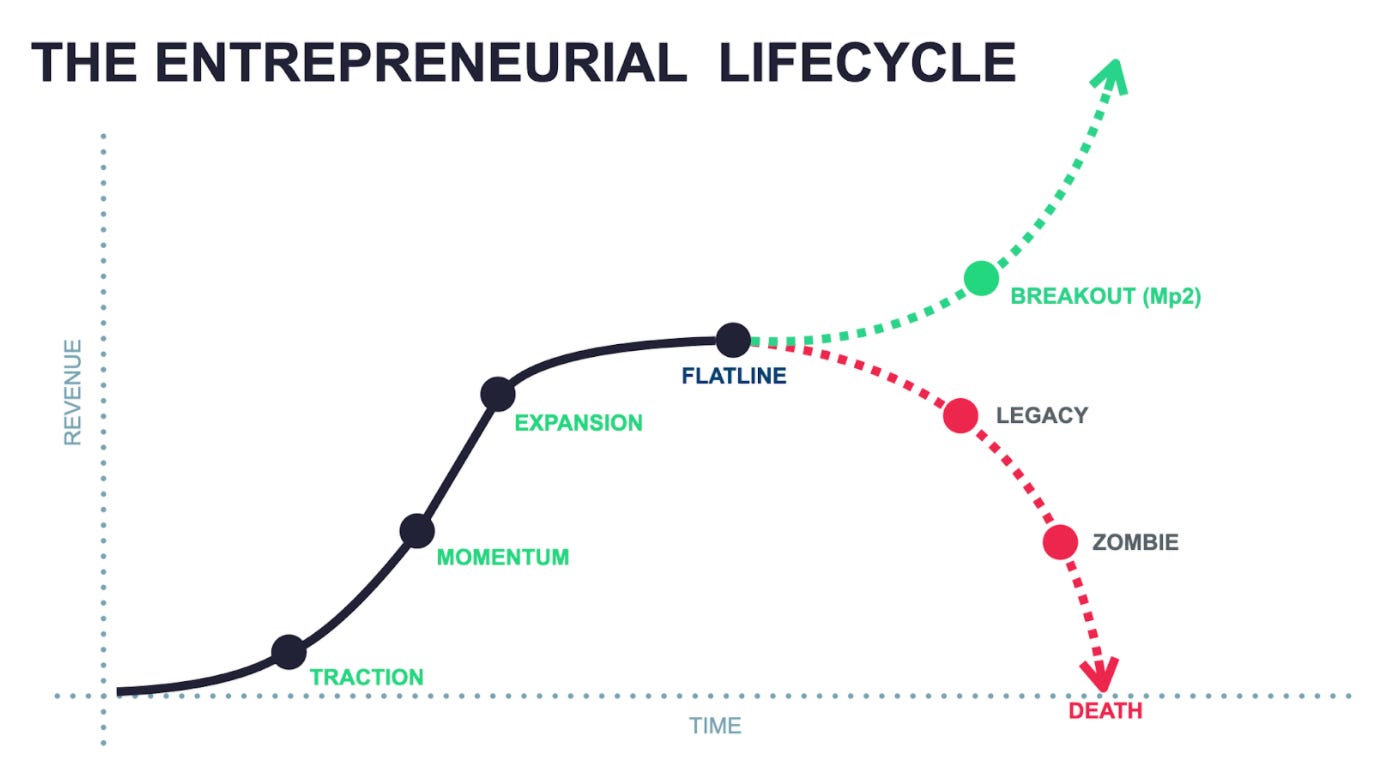
Let me be precise, because the word gets thrown around loosely.
A zombie is a venture-backed company generating enough revenue to survive but growing too slowly to achieve a meaningful exit. The rough profile: $1 to 10M ARR, under 20% annual growth, and a valuation from the last round that makes any acquisition offer look like a write-down.
Look at what that definition hangs on. It has nothing to do with whether the company is healthy, whether customers are happy, whether the product works. It hangs entirely on the relationship between the company’s growth rate and the expectations baked into its last valuation.
A company doing $5M ARR, growing 15% a year, profitable or close to it, is by almost any historical standard a good business. If you’d built that in 1995 you’d be thrilled. It throws off cash. It serves customers. It employs people who like working there. The only thing that makes it a “zombie” is that it raised money at a $40M valuation that assumed it would be doing $50M ARR by now.
The company didn’t fail. The company is fine. What failed is the match between the company and the financing structure it chose. It took on venture money, which is a specific bet that the company will grow explosively and exit large, and then it grew like a normal good business instead. Venture money is not neutral. It’s a claim on a specific future. When the company delivers a different future, even a perfectly nice one, the claim curdles into a trap.
Why nobody pulls the plug
Here’s the part that makes zombies so persistent, and it’s the thing the founder-focused advice usually misses. The zombie state survives because it’s in almost everyone’s short-term interest to let it survive.
Start with the investor. A zombie in a fund is usually held at cost with no markdown. The moment the investor writes it down or admits it’s dead, they take the loss on their books, their returns look worse, and their ability to raise the next fund gets harder. So the rational move for the investor, at least in the short term, is to leave the position marked at cost and hope something changes. The incentives genuinely favor delay over resolution.
Now the founder. Admitting the company is a zombie means admitting the last several years produced something that won’t win. It means facing the team, the early believers, the people who left other jobs. It means updating your own identity from “founder of a rocket ship” to “founder of a company that didn’t take off.” That’s brutal, and human beings are very good at avoiding brutal realizations. So the founder tells themselves the reacceleration is one feature away, one hire away, one quarter away.
And so the small raises begin. The bridge round becomes a habit, small raises to extend runway rather than to fund any genuine change in direction. Each bridge buys six months. Each six months the plan to reaccelerate quietly resets to next quarter. The company breathes for another year. Nobody has to face anything. The zombie is comfortable, in the way that not making a decision always feels more comfortable than making a hard one.
This is why zombies can persist for five, six, seven years. Everybody notices. Noticing and acting are different things, and the incentives of every party point away from acting.
The signals, in numbers
Founders are bad at knowing when they’ve become a zombie because the transition is gradual and the emotional cost of acknowledging it is high. So it helps to have some objective markers that don’t care about your feelings.
The clearest one: your burn multiple over time. If your monthly burn is running at roughly double your ARR growth rate for three or more consecutive quarters, you’re spending a lot to produce a little, and the trend isn’t improving. That’s a zombie signature. A healthy company’s burn multiple improves as it scales. A zombie’s stays stubbornly bad.
The second: unit economics that only work with the subsidy on. If your customer acquisition cost exceeds the lifetime value you’d collect in an 18-month payback window, and your monthly churn sits above 6%, then your growth was rented, not owned. The moment you turn off the ad spend or the first discount cohort expires, the gross margin collapses and the growth goes with it. A lot of companies that looked like stars during the cheap-money years were zombies wearing borrowed acceleration.
The third, and this is the one founders hate most: the reacceleration that always lives in the future. Look at your last four board decks. If every one of them has a hockey stick that starts next quarter, and next quarter keeps arriving without the hockey stick, you’re not iterating toward growth. You’re narrating a story to yourself. The plan resets every quarter because the plan was never grounded in something real.
None of these numbers care how hard you’re working. That’s what makes them useful. A founder can convince themselves that shipping velocity is progress, that a busy roadmap is the same as market pull. The numbers don’t get confused about the difference.
Activity is not the same as pull
The deepest trap inside the zombie state is the confusion between activity and progress.
A zombie company is often a very busy place. The team ships features constantly. The roadmap is full. Everyone is working hard. There are standups and sprints and launches. From the inside it feels like a company that’s going somewhere, because motion feels like progress and everyone is definitely in motion.
But market pull is a different thing from internal motion. Market pull is when customers drag the product out of your hands. When they sign up faster than you can onboard them. When they complain that they need the thing you haven’t built yet because they’re desperate for it. When they tell their friends without being asked. A company with real pull doesn’t have to manufacture urgency. The urgency comes from outside.
A zombie manufactures its urgency internally. The founder chases just one more feature instead of confronting the harder truth that the pricing is wrong, or the positioning is wrong, or the market simply doesn’t want this badly enough to pay what the business needs. Building a feature feels productive. Admitting the market doesn’t care feels like death. So the roadmap fills up with features nobody asked for, and the team stays busy, and the company stays a zombie, because activity is available on demand and pull isn’t.
The test I’d apply: if you stopped shipping new features for three months and just sold and supported what you have, would growth continue? For a company with pull, mostly yes. For a zombie, the honest answer is that the feature treadmill is the only thing generating the appearance of motion, and stopping it would reveal how little pull there actually is.
The three real options
Once you accept you’re in the zombie state, there are only three honest ways out, and most founders waste years avoiding all of them.
The first is to transform, which means a real pivot, not a feature. A genuine pivot changes a core assumption: who the customer is, what the problem is, how you charge, how you distribute. The companies that escaped the zombie state and became stars almost always did it by changing something fundamental, not by adding to what they had.
Look at how the good pivots actually work. Odeo was a podcasting startup that got run over when Apple built podcasts directly into iTunes overnight. Their whole market evaporated. Rather than slowly bleed out, the team turned to an internal side project, a short status-update tool, and that became Twitter. The lesson there is specific and harsh: platform risk can kill your entire thesis in a day, and the escape route was a thing they’d built on the side, not the thing they’d raised money to build. YouTube started as a video dating site where people uploaded clips describing their ideal partner. Almost nobody did. But the founders noticed people were uploading videos of all kinds, not just dating pitches, so they threw away the dating premise entirely and let people post anything. The pivot was subtraction: they removed the reason the product existed and kept the behavior users actually showed up for.
What these have in common is that they didn’t add. They subtracted. They found the one part of the business that had genuine pull, killed everything else, and rebuilt around the part that worked. A zombie founder’s instinct is to add features to the thing that isn’t working. The escape almost always runs the other direction: find the small thing customers actually drag out of your hands, and have the nerve to throw away the rest. The key word is measurable. A pivot that produces a new batch of the same flat metrics wasn’t a pivot. It was a redecoration.
The second is to accept the company for what it is and change the costume to fit. If the company is a good $5M business that grows 15% a year, the problem was never the company. It was the venture financing. Sometimes the move is to restructure: buy back equity if you can, get off the venture treadmill, run it as the profitable business it actually is.
Pitch, the Berlin presentation-software company, did exactly this in early 2024. They’d raised around $137 million and hit a $600 million valuation in 2021, carrying all the hyper-growth expectations that came with it. Rather than keep chasing a venture-scale outcome the business wasn’t going to reach, CEO Christian Reber and the team returned most of the unspent venture capital to investors, cut headcount hard, and reset the cap table so founders and employees would own roughly 80% of the company (TechCrunch). Reber’s own framing: a sustainable path had a much higher chance of success than the one they were on.
And it worked. Pitch reached profitability by mid-2024 and hit around $10 million ARR by early 2025, up roughly 90% year over year (Sacra). The company that looked like a stalling zombie at a $600M valuation became a healthy, profitable, growing business the moment it stopped pretending to be something it wasn’t and changed the costume to fit. The business underneath was fine all along. The thing killing it was the expectation stapled to its cap table.
Stepping off the rocket-ship narrative in public is brutal. But the alternative is worse: staying in the costume until it strangles you.
The third is to end it cleanly. Sometimes the responsible move is an orderly shutdown or an acquihire that gets your people to a place where their talent isn’t trapped. This feels like the worst option and is often the best one, because the thing a zombie consumes is not money. It’s the prime working years of talented people who could be building something with actual pull.
The acquihire has become the defining soft landing of this era, especially in AI. Microsoft absorbed most of Inflection’s team including Mustafa Suleyman in a $650 million licensing deal while leaving the company intact on paper. Amazon took Adept’s co-founders and top engineers and sidelined the product. And in August 2024, Google paid roughly $2.7 billion to license Character.AI’s technology and bring back its co-founder Noam Shazeer, along with about 30 researchers, while the company kept running as a separate shell with new management. These were companies that had raised at billion-dollar valuations and then stalled. The acquihire converted a stalling company into a stable home for the key people and at least some return for investors.
But there’s a hard truth inside the acquihire that founders need to see clearly before treating it as a happy ending. It is frequently a great outcome for founders and a bad one for everyone else. In the Character.AI deal, Shazeer reportedly made hundreds of millions from his stake, an unusually large sum for a founder who didn’t sell the company or take it public. The roughly 30 people who got Google offers did well. The couple hundred who stayed behind inherited a hollowed-out company that later ran headfirst into a teen-safety crisis and wrongful-death litigation. The pattern repeats across these deals: value flows to investors, enough to clear the preference stack, and to the specific people the acquirer wanted, structured as multi-year retention packages. Everyone else can end up with very little. If you’re going to take this exit, take it clear-eyed about who it actually rewards, and fight for the people who built the thing alongside you.
A clean ending, whatever its form, returns the one resource a zombie never gives back: time. A zombie spends the prime working years of talented people, slowly, forever, in exchange for a company that will never win.
What all three have in common: they’re decisions. The zombie state is what happens in the absence of a decision. It’s the default that fills the vacuum when nobody chooses. The single most important thing a founder in the dip can do is to actually decide, because deciding to double down and deciding to walk away are both survivable. It’s the years of not deciding that quietly destroy the most value.
The dip and the cliff
There’s an old idea that after the initial excitement of any hard thing, there’s a dip, a long valley where it stops being fun and starts being work, and where most people quit. The people who push through the dip get to the good part on the other side. The whole skill is knowing whether you’re in a dip that ends or on a cliff that doesn’t.
The reason this is hard is that a dip and a cliff feel identical from the bottom. Both are dark. Both make you want to quit. What separates them is underneath, out of view. A dip has something real on the other side: a market that wants this, unit economics that work once you reach scale, pull that’s building even if you can’t see it yet. A cliff has none of that. It’s just a slope that keeps going down, and the effort you’re spending buys nothing.
The venture zombie is usually a company on a gentle cliff that everyone keeps insisting is a dip. The reacceleration is always next quarter. The pull is always about to show up. And because the company doesn’t die, because it keeps breathing, the cliff never forces the reckoning that a cash-out would. The company can descend the gentle slope indefinitely, one bridge round at a time, and the very fact that it survives is what prevents anyone from admitting it should have changed course years ago.
The uncomfortable truth is that a quick death is sometimes a gift, because it forces a decision. The zombie’s curse is that it removes the forcing function. It gives you the option to never decide. And for founders, who are selected for optimism and persistence, the option to never decide is the most dangerous option of all, because they will take it, quarter after quarter, until the years are gone.
Thanks for reading.
If you enjoyed this issue, send it to a friend—it helps more than you think.
Back in your inbox Thursday,