
Hey 👋, Happy Thursday!
December always hits a little different. Year-end sprints, half-empty offices, too many holiday plans, and everyone trying to squeeze in one last burst of progress before things slow down. Good energy all around.
Let’s jump in.
Before we begin... a big thank you to this week’s sponsor

Launch fast. Design beautifully. Build your startup on Framer — free for your first year.
First impressions matter. With Framer, early-stage founders can launch a beautiful, production-ready site in hours. No dev team, no hassle. Join hundreds of YC-backed startups who launched here and never looked back.
One year free: Save $360 with a full year of Framer Pro, free for early-stage startups.
No code, no delays: Launch a polished site in hours, not weeks, without hiring developers.
Built to grow: Scale your site from MVP to full product with CMS, analytics, and AI localization.
Join YC-backed founders: Hundreds of top startups are already building on Framer.
👉 Apply to claim your free year →1
If you’re interested in sponsoring this newsletter, please reach out here.
The startup world has a sameness problem. And it’s not what you think.
Ten minutes on Product Hunt and you start experiencing déjà vu. AI for sales outreach, AI for customer support, AI note takers, AI agents scheduling meetings and filing tickets—everything looks competent, funded, and safe. Almost nothing looks genuinely strange or hard to explain at Thanksgiving dinner.
This isn’t a creativity crisis. Smart, weird people exist in abundance. It’s an optimization crisis. We’ve built a system that systematically filters out deviance, rewards legibility, and crushes secrets the moment they surface. The result is a startup scene dominated by technically proficient cover bands instead of people inventing new genres.
When everyone has more to lose
In the 1990s, starting a company meant stepping sideways off the default path. You weren’t giving up multi-million dollar RSU packages at FAANG companies, a polished LinkedIn presence, or a well-groomed personal brand. You probably hadn’t spent four years reading startup blog posts and participating in founder communities designed to teach you the “correct” way to build a company.
Flash forward to 2025. The typical modern founder did everything “right”:
Good school
Brand name internships
Big Tech or a buzzy unicorn
YC Discords, On Deck, paid communities, “founder fellowships”
They have status, optionality, and a visible track record. Their downside risk is much more salient than their upside potential.
If the company flops in some weird, illegible space, that failure sticks to them on the internet forever. But if it fails in a respectable, consensus category? That becomes a polished story. “We built an AI workflow tool for finance teams, raised a few rounds, got acqui-hired.” Not world-changing, but it plays well on conference panels and in future job interviews.
So founders quietly optimize for reputation risk rather than tail outcomes. They choose ideas that sound obvious in partner meetings. They pick markets that already have established categories on analyst landscape slides. They chase whatever theme is trending on VC X.com because being “in the conversation” feels like insurance against being forgotten.
The data backs this up, though not in obvious ways. US business entry rates drifted downward for decades from the late 1970s, even as survival rates improved. Fewer people started from scratch. More chose stable paths. The people who would have done the truly deviant startup are now optimizing their LinkedIn profiles instead.
This connects to a broader cultural shift. Psychologist Adam Mastroianni documents a broad decline in “deviance” across society, backed by data on declining teenage substance use, risky behavior, and even adult crime rates. The explanation isn’t moral improvement—it’s economic. When wealth increases, life expectancy improves, and material safety rises, the “value of a statistical life” goes up. People have more to lose, so they play it safer.
The same logic applies cleanly to founders. When you’re born into milk and honey, you adopt what researchers call a “slow life history strategy.” You choose Pilates over drunk driving, 401(k) contributions over unprotected risk-taking. Getting an elite degree should theoretically increase options, but instead makes students too afraid to choose any but the safest paths. Half of Harvard graduates go to finance, tech, or consulting—not because they love these fields, but because they’re safe, lucrative, and prestigious.
Metric brain and the tyranny of perfect data
Writer Derek Thompson argues that culture looks “stuck” because we finally have good data on what works. Streaming platforms tell labels exactly which tracks people replay. Global box office numbers tell studios exactly what sells. Corporate logos all converge on similar visual styles because A/B tests keep pointing to the same safe aesthetic choices.
Once you know what worked the last ten times, the obvious move is to keep doing more of those things. The system becomes excellent at remixing, terrible at inventing.
Startups are now built inside that same feedback environment.
We have YC’s public content and playbooks.
Thousands of SaaS benchmarks.
Growth rate templates, funnel templates, magic-number posts, “good” Series A metrics.
X.com threads that try to reduce every messy company to a ten-bullet recipe.
This stuff is genuinely useful. It also plants a subtle idea in everyone’s head: there is a correct way to start a company.
Founders see that investors want quick proof, and they reverse engineer it. Instead of asking “what is the strangest thing I deeply understand,” they ask “what idea gives me clean LTV/CAC charts in eighteen months.” You get companies designed to look perfect in data rooms rather than companies designed to chew through reality in unexpected ways.
Investors play the same game from the other side. After a decade of ZIRP noise and high-profile frauds, there’s intense desire for legible traction and easy comparables. The fastest way for a founder to provide that is building yet another tool in a category where comps already exist.
Everyone gets trapped in what organizational theorists call a “competence trap.” The system improves at a narrow set of moves while losing the ability to explore moves that don’t obviously improve next quarter’s numbers.
The same pattern appears in science. Despite more scientists and more papers than ever, experts rate recent discoveries as less impressive than older ones, and truly disruptive work has slowed relative to the number of researchers. People flood into safe topics with clear citation networks and established grant pathways.
In startups, the safe topic is “put AI in this existing workflow and sell it to the same buyer everyone already knows.” The AI funding data confirms this. In 2024, startups offering AI tech represented 37% of venture funding and 17% of deals, both all-time highs, with nearly three in four AI deals being early-stage as investors stake out claims to reap potential rewards. But the rush creates homogeneity, not innovation.
The tribute-band startup economy
In music and film, the past dominates the present. Old songs control streaming charts. Old IP controls screens. Investors and studios love buying catalogs and franchises because the risk models look cleaner.
Tech has its own version: the tribute-band startup.
You know the pattern. “Notion for X.” “Shopify for Y.” “Figma, but for this department.” “Agentic AI version of this product that already works.”
Some of these will become solid businesses. Many will remain indistinguishable. The real problem isn’t cloning itself—”X for Y” can be a legitimate wedge if Y is genuinely underserved. The problem is when every ambitious person in the ecosystem tries to front the same tribute act because that’s where capital and social validation concentrate.
Two things make this worse now:
Instant idea propagation.
The moment something shows a hint of traction, it is everywhere. Funding announcement. Podcast. Thread. Conference panel. Within months there are dozens of barely differentiated clones. Secrets do not stay secret long enough to compound.Low marginal cost of building.
Open source, APIs, and now foundation models make it incredibly cheap to spin up a functional product. Investors and founders both know this. So they treat almost every visible idea as a race, not a frontier. If you are not first, you grab your piece, brand it slightly differently, and hope to flip it.
The result is a scene full of technically competent cover versions that rarely push the form. Good enough to sell, not weird enough to matter.
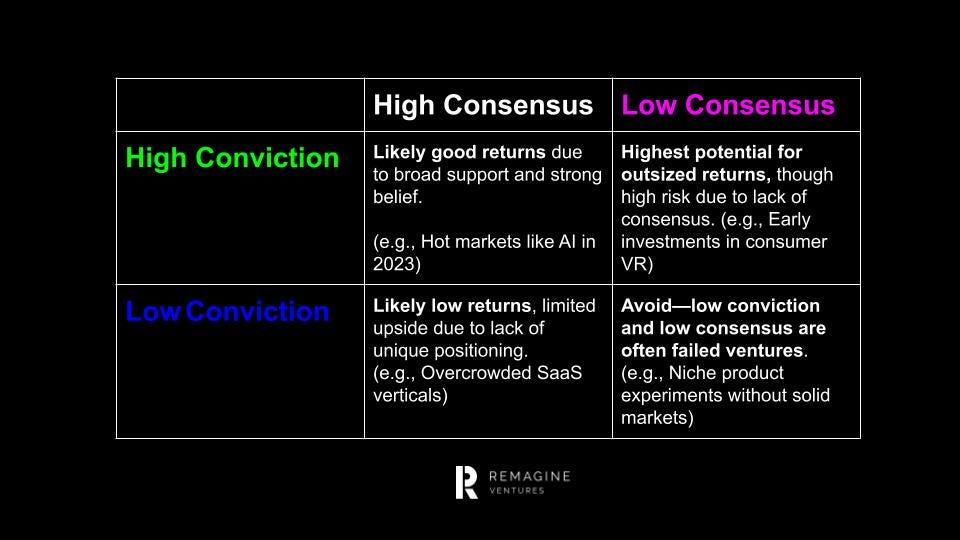
Research from Cambridge Associates reveals that the most lucrative venture returns come from high-conviction bets that initially faced widespread skepticism. The investments that generated exceptional returns were often those that struggled to attract initial investor interest. Yet the current system pushes everyone toward consensus deals.
Analysis by Correlation Ventures found that non-consensus investments generate 3-5x higher returns compared to consensus deals, and approximately 40% of top-performing venture investments were initially considered “contrarian” or “unlikely to succeed”. But building a non-consensus company requires tolerating being misunderstood for longer than is comfortable, and the modern startup ecosystem has systematically filtered out people willing to endure that.
What “weird” actually looks like in 2025
It’s easy to say “we need more weird startups.” Harder to define what that means in practice without sounding like you’re romanticizing chaos for its own sake.
Weird has nothing to do with vibes or aesthetic choices. It has to do with illegibility.
A weird company is one where:
The market is not an obvious category on a MarTech landscape slide.
The early traction looks like noise to casual observers.
The founder cannot summarize the company in a clean “X for Y” line without lying a little.
The sales motion or product stack would be hard to copy even if you open sourced half of it.
You can see early hints of this in a few places:
Deep industrial automation, where code controls physical processes that most software investors have never seen up close.
Frontier biology and climate tech, where the timelines, regulatory structures, and science risk are alien compared to SaaS.
Boring, regulated, low-margin niches that software people hate, which makes competition thin.
These are not necessarily glamorous. Which is sort of the point. When everyone wants to work on AI tooling for other AI companies, the biggest alpha might be in freight, wastewater, or weird subsegments of insurance.
Mastroianni and Thompson describe “good deviance” as a scarce resource—not crime or self-destruction, just people willing to ignore the prevailing script long enough to create something that looks wrong until it works. The startup world has systematically filtered those people out or converted them into consultants and content creators.
Reversing that filter means making peace with being misunderstood for a while.
Escaping the safe-startup gravitational pull
If you are a founder or investor reading this, “be weirder” is not exactly actionable. So here are a few more concrete moves that fall out of the research and the pattern.
A. Optimize for secret density, not TAM slides
Most pitch decks still lead with market size. That is backwards.
The interesting question is: “What do you know that almost nobody else in this room knows, and that actually matters for how this market works?”
Secrets often live in unsexy places:
A broken payment flow in a specific trade vertical.
A messy operational constraint in a physical industry.
A regulatory artifact that makes some moves impossible and other moves extremely valuable.
Finding those requires deviance in the Mastroianni sense. You have to talk to people others do not talk to, spend time in places VCs do not hang out, and risk being seen as “wasting your talent” on something small and weird.
B. Ignore the generic benchmarks for longer than is comfortable
Benchmarks are useful once you have something real. Before that, they are a trap.
If you are doing something frontier or illegible, early numbers will look terrible by standard SaaS metrics. Sales cycles will be wrong. Pricing will be weird. Adoption will not follow the neat S-curve that some growth essay told you to expect.
You can try to force your company into the template anyway. Or you can accept that you are playing a different game and optimize for depth of product moat and quality of insight.
One way to check yourself: if your whole strategy fits neatly into a twenty tweet thread, you are probably not weird enough.
C. Bet on founder taste and scar tissue, not category keywords
From the investor side, pattern matching is comfortable. It is also how you quietly end up with a fund full of competent, mid-upside deals.
Instead of asking “do I like this category,” better questions:
Has this founder spent an unreasonable amount of time around the underlying problem?
Do they have a real allergy to lazy consensus?
Are they willing to pick a fight with how the market works, not just add another tool to the stack?
If the answer is “yes” and the deck looks slightly insane, that is probably a better bet than the fifteenth vertical AI assistant this month.
D. Protect illegibility
The moment something starts to work is the moment the tribute acts appear.
If you are lucky enough to stumble into a genuine secret, you need to:
Delay the thought leadership circuit.
Stay away from over-sharing your playbook in public.
Be careful about what you show in case studies and “how we built X” posts.
This is not about being stealth forever. It is about buying enough time for your weirdness to compound before the clones arrive.
The small upside of a consensus pileup
The good news in all this: the more capital and talent crowd into the same obvious AI categories, the more open field exists elsewhere.
When VCs are busy funding the twentieth AI sales agent and founders are optimizing for Medium posts about outbound conversion, the following things become possible:
You can quietly build a monopoly in a dusty vertical no one is tracking on Twitter.
You can experiment without a chorus of hot takes judging every metric.
You can recruit people who care more about the problem than the badge.
History is not all progress, but it is also not pure loop. New forms do show up. Almost always from people who were willing to look wrong and wasteful for a while.
Right now the startup ecosystem skews heavily toward the opposite type of person. The ones who treat founding as a prestige career rather than a deviant act.
The decline of deviance is mainly positive—lives are longer, safer, healthier, richer—but the rise of prosperity and disappearance of everyday dangers makes trivial risks seem terrifying. For the first time in history, weirdness is a choice, and it’s a hard one because we have more to lose than ever.
If we want interesting outcomes—art that excites us, companies that reshape industries—we need to reintroduce some deviance. Less optimization of reputation, more tolerance for weird timelines and opaque problems.
The cover bands will keep playing the AI hits. They’ll fill conferences and stack moderate exits. The interesting question is who’s in the back room working on songs nobody recognizes yet.
Because right now, the venture capital data tells a clear story. In 2024, 277 startups closed their doors for good, marking a 29% increase from 2023, with 109 of those companies having raised at least $20 million. The ZIRP phenomenon created a competence trap that’s now unwinding. The best firms of this vintage will be the ones that find a way to reinvent themselves rather than optimize the playbook that stopped working.
The system has become excellent at producing safe, legible, fundable companies that look perfect in spreadsheets. What it’s terrible at is producing companies that invent genuinely new categories, attack problems everyone else thinks are unsolvable, or build products that seem slightly insane until they become obvious in hindsight.
The founders who figure out how to be productively deviant in this environment—who can navigate the tension between having something to lose and being willing to do weird things anyway—those are the ones who’ll build the next wave of companies that actually matter.
Thanks for reading.
If you enjoyed this issue, send it to a friend—it helps more than you think.
Back in your inbox Tuesday,
Kenneth F.
Eligibility: Pre-seed and seed-stage startups, new to Framer.