Sell It Yourself
The three things that close early-stage deals and none of them are a sales deck

Hey there! 👋
You're reading Open Scout 👀
Hiring a salesperson before you’ve closed your first 30 customers is probably the most expensive mistake a startup can make. Not because salespeople are bad. Because a salesperson executes a process. If you don’t have a process, you’re paying someone six figures to invent one, and they’re less qualified than you. They don’t know the product or the problem or the market the way you do. You built the thing.
You wouldn't hire a pilot before building the plane. Same logic applies.
Open Scout Exclusive: Get Early Access to AI Startups Like These

Open Scout and Alumni Ventures are giving readers early access to high-growth startup opportunities, including some of today’s most exciting AI, Deep Tech, Quantum Computing, and Cybersecurity companies co-invested alongside top VC firms like Andreessen Horowitz (a16z), Bessemer, & Y Combinator.
You get:
Curated deal flow of high-potential AI First startups
AV is already investing alongside elite lead venture firms in these deals
No cost to see deals
No obligation to invest
Don’t miss your chance before access closes.
If you’re interested in sponsoring this newsletter, please reach out here.
And honestly the case for doing it yourself goes way beyond “you give a better pitch.” In those first 30 conversations you’re doing four things at once that no hire can replicate. You’re selling. You’re doing customer discovery, finding out what the product actually does for people which is almost never what you think it does. You’re gathering competitive intelligence, hearing what prospects tried before you and why they left. And you’re refining your positioning live, adjusting the story based on what lands and what doesn’t. A hired salesperson does maybe one of those. You do all four. Every call is a sale AND a research project, and that intelligence shapes everything that follows. Pricing, roadmap, ICP, messaging. All of it.
But conviction alone closes maybe 2 out of 10. What separates founders who close 6 or 7 is having a structure for how the conversation flows. Not a script. A framework. Three things make up the working version of that framework.
One thing worth internalizing before any of this: your first 30 customers are NOT mainstream buyers. They’re early adopters. The psychology is completely different. Mainstream buyers want proven, safe, recommended by peers, low-risk. Early adopters want new. They want to be first. They’re OK with rough edges because they’re buying the trajectory, not the current state. The messaging that works on them sounds nothing like enterprise sales. “We’re the leading platform for X” won’t work because you’re obviously not the leading anything yet and they know it. What DOES work: “We’re building something new that solves [specific problem] and the early companies using it are seeing [specific result]. Would love your input on where to take it.” That’s an invitation, not a pitch. Early adopters respond to being part of building something. Use that.
Your story is your first sales asset
Before customers, before case studies, before the deck, you have the story of why this company exists. Most founders either skip it entirely or compress it into one forgettable slide. Huge mistake.
Your product pitch is basically redundant by the time someone takes a meeting with you. They’ve already read the site, checked G2, maybe asked around (Gartner says buyers spend only 17% of purchase time actually meeting suppliers). What they CAN’T get from your website is the human reason you built this. That’s the part that cuts through.
“Buyers don’t need another friendly vendor. They need someone who understands their problem better than they do.”
The structure of a good founder story:
Who you were and what you were doing. Specific. “I was managing procurement for a mid-size construction firm and losing two days a week chasing change orders across email, spreadsheets, and three systems that didn’t talk to each other.”
What it cost. Real numbers. “Roughly $180K a year in unbilled change orders because nobody could track them in real time.”
What you tried that failed. This matters because the prospect has probably tried the same things. “Built a tracker in Airtable. Looked at Procore but it’s designed for GCs not specialty subs. Hired a part-time admin just to reconcile data.”
What you realized. The reframe. THIS is the commercial teaching moment. “The problem wasn’t tracking. Change orders were being created in conversations, on job sites, in texts, before they ever entered any system. By the time anyone logged them, the information was already wrong.”
What you built. One sentence. “So I built a tool that captures change orders at the point of conversation, before they hit any system of record.”
Takes about two minutes. Doesn’t feel like a pitch. Feels like someone who cares about a problem explaining what they found. If the prospect has the same problem they’re nodding before you finish.
Sometimes they’re not nodding. The founder story doesn’t always land because not every prospect has your exact problem. Some have an adjacent version. Some have something completely different that your product also solves but from a different angle. The skill here is reading the room and pivoting. If the founder story isn’t getting traction, stop telling it and start asking. “That’s how we got here. But I’m curious, what does this problem look like from your side?” Let them tell you their version. Sometimes their version is better than yours and becomes a customer story you use in the next conversation. The founder story is your opening. It’s not a monologue you deliver regardless of what’s happening on the other side of the call.
Credibility through other people’s stories
Your story creates trust. But the prospect’s question is always “does this work for companies like mine?” That’s where customer stories come in. Even one customer. Even a beta user. Even a discovery conversation where someone described the exact pain.
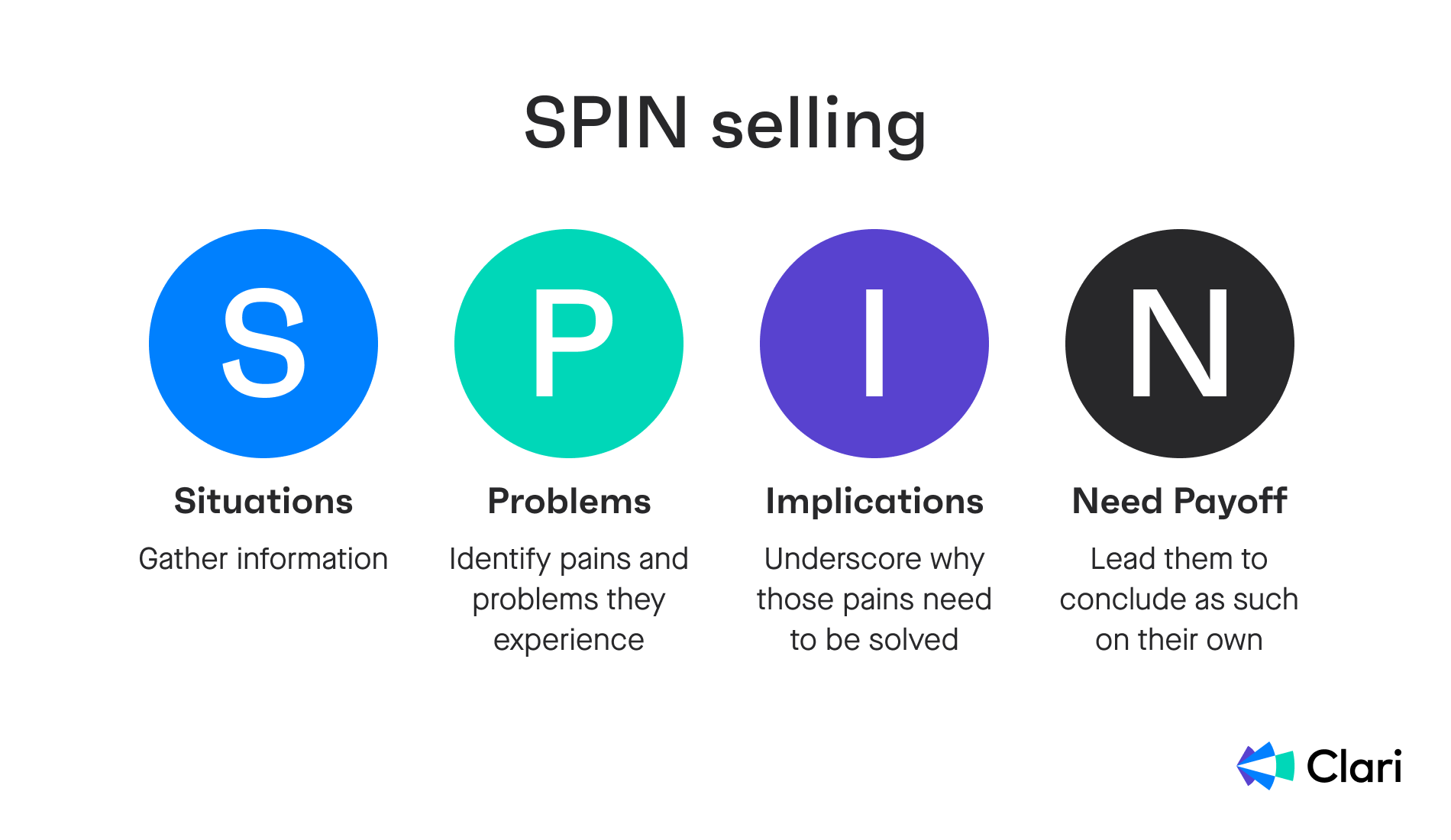
What makes a customer story actually convert is specificity. Vague stories (”our customers love it”) do nothing. Specific stories (”a 40-person electrical sub in Phoenix was losing 12 hours a week on change order reconciliation, within six weeks that dropped to under 2”) make the prospect’s own vague frustration concrete and urgent. In SPIN Selling1 terms, you’re moving them from an implied need to an explicit need. “Yeah reporting is annoying” becomes “wait, this might be costing us $200K.”
Structure:
Someone who looks like them. Match on whatever’s relevant. Industry, size, stage, tech stack. The prospect needs to see themselves in the story.
Their specific pain. Connected to what you’ve already heard in THIS conversation. If the prospect just described a change order problem, your story better be about change orders. Having three or four stories to choose from is where the real leverage is. You pick the one that mirrors their situation.
What happened, quantified. “Caught $340K in previously unbilled changes in the first quarter. Their PM team got 10 hours a week back.”
Objections handled through narrative. When someone says “our team won’t adopt new software,” don’t argue. Tell a story about a customer who said the same thing and how it played out. This actually works better than arguing because psychologically, when a prospect raises an objection, they’re mentally simulating owning your product and testing failure scenarios. They’re engaged. A prospect raising zero concerns is often a prospect who isn’t seriously considering you at all.
The transition from your story to the customer story should feel seamless. “I had this problem running procurement at my firm. When we started working with [Company], they had it worse, 22 active projects and not a single change order captured at the source.” Your credibility flows into their proof.
Building a story library. Record every call. After each meaningful conversation, write a one-page story within 24 hours while details are fresh. Tag by industry, size, pain point, buyer title, objections handled. Review quarterly. Cut what doesn’t land, double down on what closes. This becomes a compound asset over time. Every new story makes every subsequent conversation stronger because you’re selecting from proven material instead of improvising.
The conversation itself
Most founders wing their calls and can’t tell you why some go great and some go nowhere. The good ones always have a question sequence, even if the founder doesn’t realize they’re running one. Here’s what the sequence looks like when it works:
Start with context, but barely. Two or three questions about how they currently do things. “Walk me through how a change order moves from the job site to your billing system right now.” That’s it. Don’t spend 15 minutes auditing their setup. You should already know most of this from researching them before the call. Too many context questions and the prospect feels like they’re filling out a form.
Surface the specific pain. “What happens when a change order gets created on site but doesn’t make it into the system for three days?” “Where does the data break down between field and office?” You’re looking for the moment where they describe something that frustrates them. That frustration is the thread you’re going to pull.
Pull the thread hard. This is where most founders stop too early and it’s where deals are actually won or lost. The prospect said change orders get lost. OK, but what does that MEAN? “If that’s happening across 15 projects simultaneously, what does that do to your monthly billing accuracy?” “How does that affect the GC relationship when numbers don’t reconcile at closeout?” “What does your team spend per week just tracking this down?” You’re helping them calculate the real cost of the status quo. The vague “yeah it’s annoying” becomes a dollar figure. When the prospect says a number out loud, they’ve just sold themselves on needing a fix. Your job is now just to show them yours.
Let them describe the solution. “If you could capture every change order at the point of conversation, before it enters any system, what would that free up for your team?” This is powerful because the prospect is now articulating the value in their own words. They’re not hearing your pitch. They’re building the case themselves.
After this sequence, one of two things is true: the prospect is a fit, or they’re not. Both are good outcomes. If they’re not a fit, WALK AWAY. Walking away from a bad-fit prospect is one of the most valuable things you can do early on. Bad-fit customers churn fast, demand features that warp your roadmap, leave negative reviews, and eat support time that should go to your best accounts. A customer who shouldn’t have bought is genuinely worse than no customer. Saying “honestly, I don’t think we’re the right solution for what you’re describing” builds credibility and saves months of pain. They might even refer you to someone who IS a fit. Disqualification is a skill, not a failure.
When the fit IS there, you need to figure out four things before the call ends:
Can they pay? “How do you typically evaluate tools like this? Is there budget for it?” Simple question, tells you everything about whether this is a real opportunity or a tire-kick.
Who decides? “Who else would need to be involved?” This matters more than founders realize. Most B2B purchases involve 6 to 10 people per Gartner. The person on the call might love you and still need three sign-offs.
What’s the timeline? “Have you purchased something like this before? What did that process look like?” This tells you whether you’re closing in two weeks or two quarters, and whether there’s legal or procurement process that’ll slow things down.
Who’s your champion inside? This one doesn’t get discussed enough. You’re not just selling to the person on the call. You’re arming them to sell on your behalf in meetings you’ll never be invited to. The budget review. The team discussion. The Slack thread where someone asks “has anyone tried anything for this?” Give your champion ammunition: ROI numbers they can paste into an email, comparison points for when their boss pushes back, a one-page summary they can forward without explaining it. Champions close deals in rooms you’re not in. Whether they succeed depends on the material you gave them.
Then close. Actually close. “Based on what you’ve told me, I think [specific plan] solves this. Should I send over a proposal?” Direct. Not aggressive. Just clear. The number of founders who have great conversations and then say “let me know if you’re interested” instead of asking directly is staggering. You uncovered real pain. You matched it with a story. The ROI is sitting right there. Say the words.
If it doesn’t close on the call, nail down what happens next. Your deliverables. Their steps. Follow-up meeting scheduled before you hang up, with an agenda both sides agreed to.
When to stop doing this yourself
Five questions. If any answer is no, keep selling:
Can you describe your ICP in one specific sentence?
Can you predict before a call whether a prospect will close, and mostly be right?
Can someone else deliver both stories as convincingly as you?
Is your process documented, not just instinct?
Is the pipeline physically too large for one person?
When all five are yes, hire an Account Executive who executes the playbook. Not a VP of Sales. You built the strategy already. You need hands.
The handoff: ride along on calls for two weeks. Have them listen to your recordings. Give them the story library. Have them deliver the founder story while you’re in the room. Give feedback after. Good stories transfer, but they need practice before they sound natural in someone else’s voice.
Your first 30 customers aren’t just revenue. They’re showing you what your product actually does, who it’s for, what they’d pay, and how they describe the problem to colleagues. That last part, the customer’s own language for your product, is more valuable than any internal positioning exercise. Every conversation teaches you something a salesperson’s CRM notes would never capture.
And those 30 conversations are also your pricing lab. You should be testing different price points, different packaging, different value metrics with almost every prospect. Watch how they react when you say the number. Immediate “sold” means you’re too cheap. Hesitation and questions about scope means you’re in the right range. Hard no means you either priced too high or haven’t built enough perceived value, and which one it is tells you something important. “What would you expect to pay for this?” is a question you should be asking constantly. The intelligence from pricing conversations shapes your model more than any spreadsheet exercise. By customer 30 you should know your pricing with confidence, because you’ve tested it 30 times with real money on the table.
That’s why you do the first 30 yourself. The intelligence is the point.
Thanks for reading.
If you enjoyed this issue, send it to a friend—it helps more than you think.
Back in your inbox Monday,
a questioning framework for uncovering buyer pain