

Hey there! 👋
You're reading Open Scout 👀
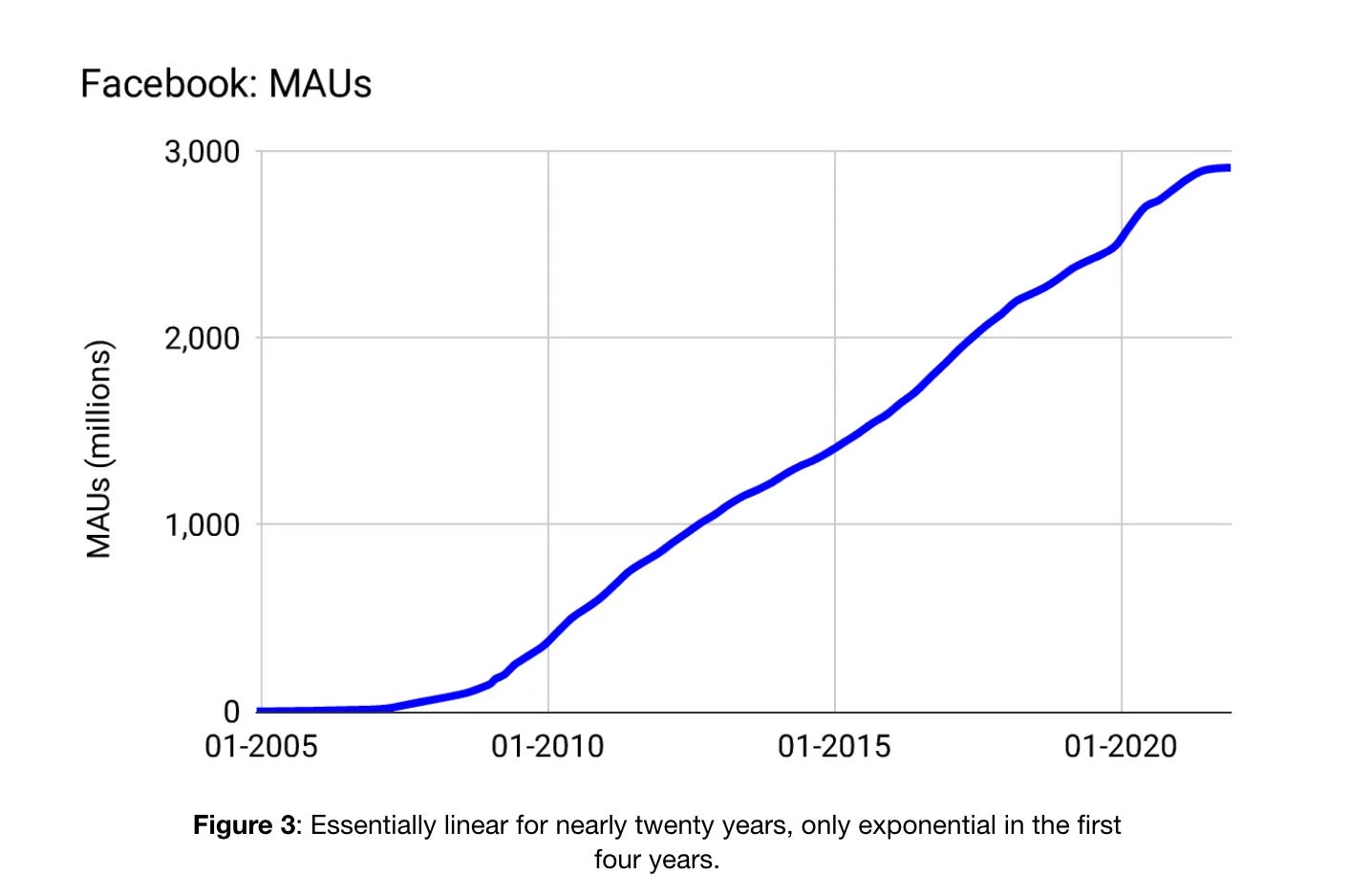
Look at Facebook’s actual user growth data. Not the narrative. The data. Monthly active users grew essentially linearly for nearly twenty years. Only the first four years looked exponential. After that, Facebook added roughly the same number of users each year. Not a multiple. A constant increment.
Slack went from 0 to 10 million active users in five years. Fastest enterprise software ever. Viral product: organizations invite members who create groups and invite more. The growth data? Accelerating for the first couple of years, then purely linear for the rest.

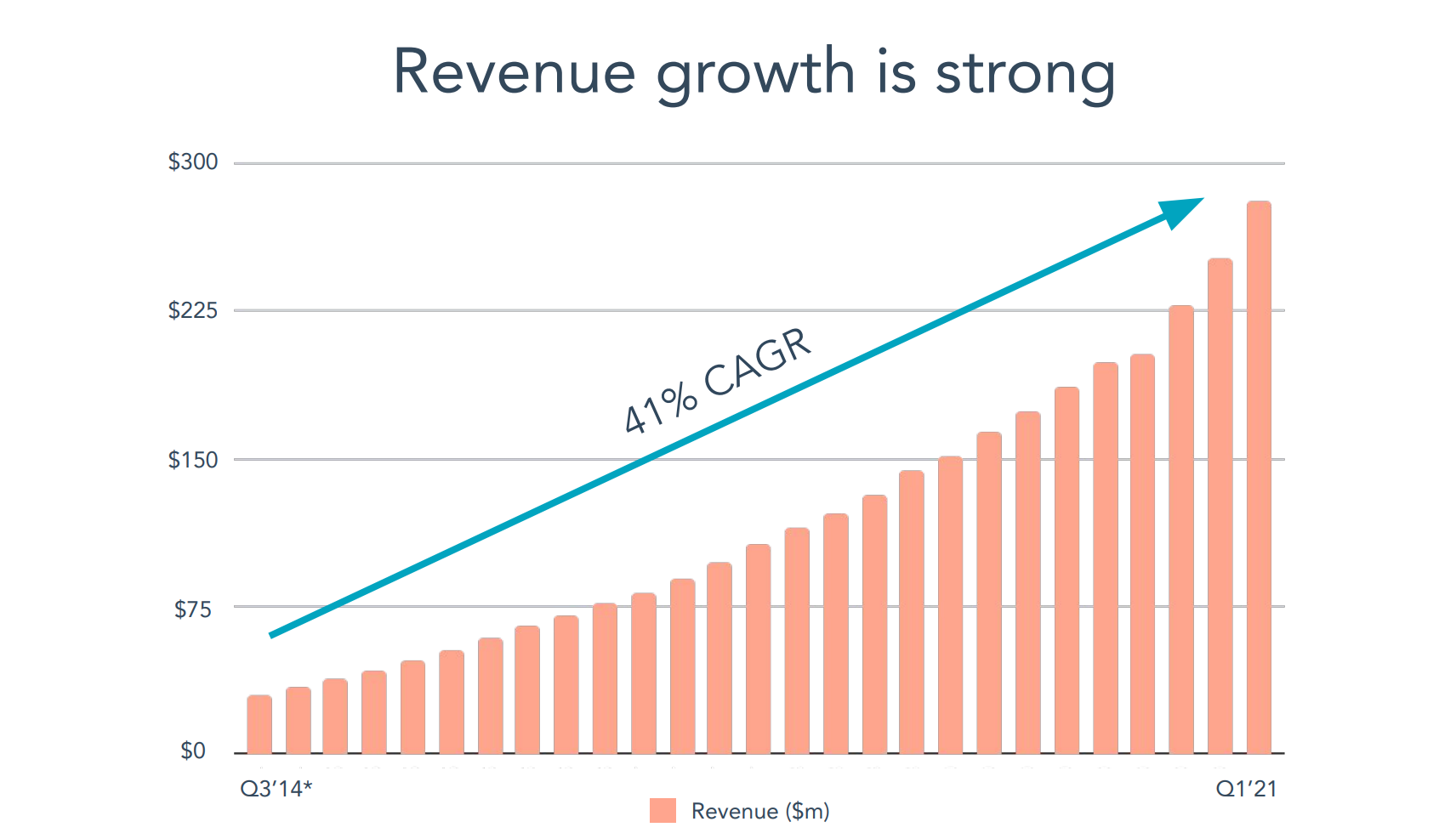
HubSpot grew $17 million in its first set of four quarters. Then $23 million. Then $28 million. Then $34 million. Each year, $5-7 million more than the last. Adding a constant amount more each period. Not compounding. Adding.
The fastest-growing companies in the history of technology didn’t grow exponentially. Their pitch decks said exponential. Their narratives said exponential. Their actual revenue and user data said something completely different: growth that ACCELERATES (each period adds more than the last) but doesn’t COMPOUND (each period doesn’t multiply the last).
Why does this matter? Because if you think growth compounds like interest, you make one set of decisions. If you understand growth actually comes from stacking multiple initiatives, each with its own lifespan, you make completely different decisions. And the second set of decisions is the one that actually sustains growth past the first few years.
Before we begin... a big thank you to this week’s sponsor: Reevo

Stop Managing Activity. Start Directing Revenue.
Sales leaders spend more time chasing status updates than closing deals. Reevo changes that.
Built for the AI era, Reevo is the revenue platform that knows your business inside and out. It captures every signal, retains full context on every deal, and puts AI to work on the tasks slowing your team down — research, logging, flagging risk, and more.
The result? Your reps stop running a marathon of sales activities and start directing outcomes. They show up to every customer interaction informed, prepared, and ready to win.
One platform. Every signal. AI that works. Intelligence that compounds.
If you’re interested in sponsoring this newsletter, please reach out here.
Every growth initiative dies
Here’s something nobody puts in a pitch deck: every growth channel, every marketing campaign, every product line, every distribution strategy has a lifespan. It launches, it accelerates, it peaks, and it declines. The timeframe varies. A paid campaign might peak in weeks. A product line might peak in years. But the shape is always the same.
Why decline is inevitable:
Audience saturation. Everyone who was going to see the ad has seen it. Everyone in the target segment who was going to sign up has signed up. The addressable pool for THIS specific initiative gets fished out.
Channel economics shift. For auction-based channels (Google Ads, Facebook Ads, newsletter sponsorships), competitors bid up the same inventory. What was cost-effective at $2 CPM becomes uneconomical at $12. Your campaign didn’t get worse. The channel got more expensive.
Novelty wears off. Users respond to new things. The first time someone sees your creative, your product announcement, your content format, it gets attention. The twentieth time, it’s background noise. The format itself degrades through repetition.
The channel itself declines. Platforms lose users. Newsletters lose readers. Podcasts lose listeners. Events lose attendance. The channel that was perfect two years ago might not exist in three.
None of this is failure. All of it is physics. Every growth initiative has a natural lifespan, and pretending otherwise is how founders get blindsided when something that was working stops working and they don’t understand why.
What sustained growth actually looks like
If every individual initiative peaks and declines, sustained growth can only come from one place: starting new initiatives before the old ones die.
Plot all of a company’s growth initiatives over time and you see it clearly. Each one follows its own curve: up, peak, down. But new ones start while old ones are still running. The sum of all the curves keeps growing because each new initiative adds to the total before the previous ones have fully declined.
This is literally what happens inside HubSpot. They started as marketing automation. That curve grew, peaked, and eventually flattened relative to the company’s ambitions. They launched a sales CRM. New curve. Then customer service. Then CMS (which noticeably shifted their year-over-year revenue growth to a new, higher linear rate). Then operations software. Each product was a new growth initiative layered on top of the previous ones.
Rippling built 25 products in nine years and reached a $16.8 billion valuation. Every product is its own initiative with its own trajectory. Payroll, IT, identity, expenses, benefits. The insight from how they built it: they created a shared employee data graph underneath everything, so each new product launches faster and integrates deeper than it would as a standalone. The infrastructure made new initiatives cheaper to start and more valuable to the customer.
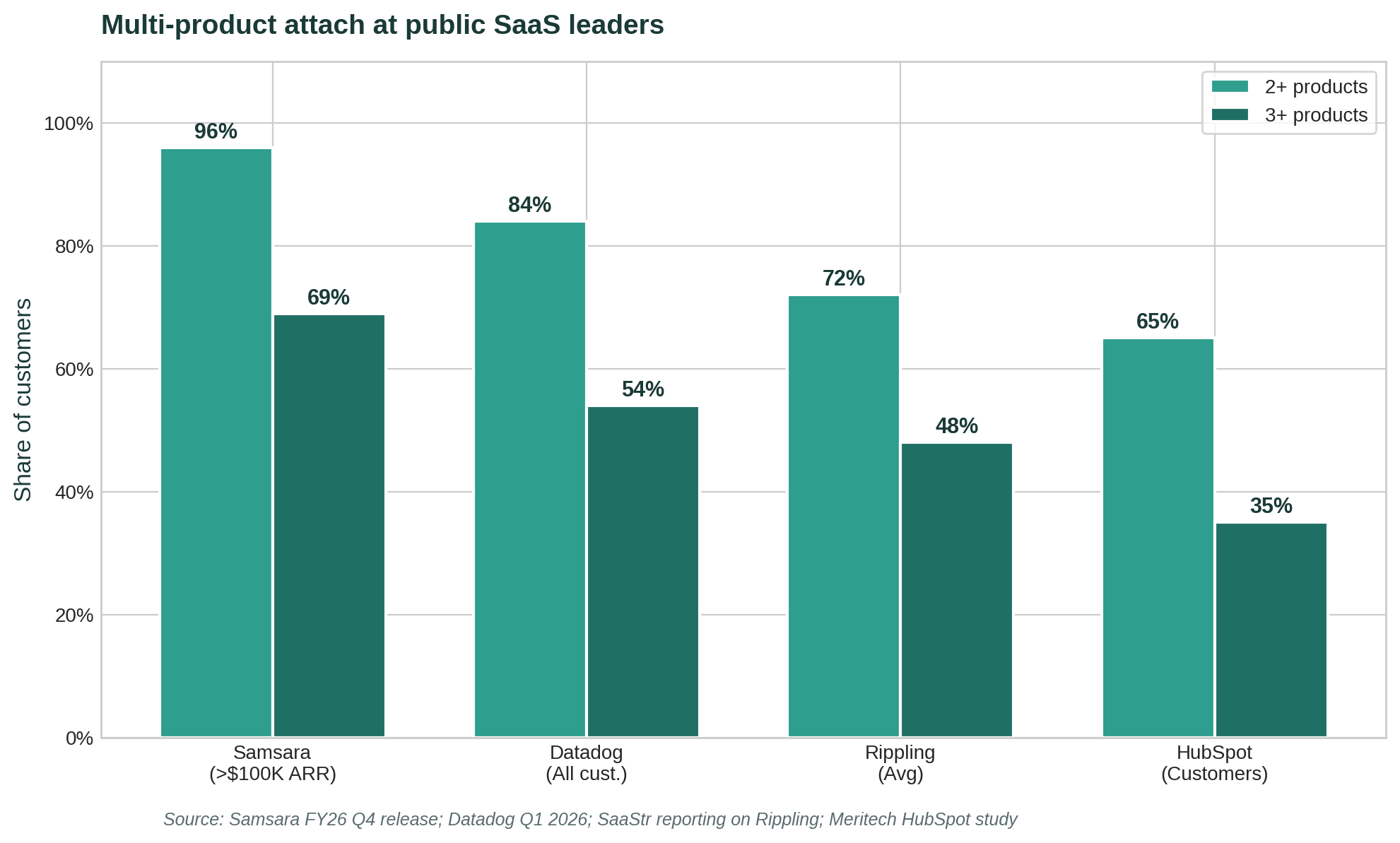
Datadog has 84% multi-product attach. Their customers use multiple products. Each product reinforces the others. The total keeps growing because new products add revenue AND increase switching costs on the existing base.
The pattern: what looks like one company growing smoothly is actually a portfolio of initiatives at different lifecycle stages, some accelerating, some peaking, some declining, and new ones being seeded.
The timing problem
The hardest decision in growth is when to start the next initiative.
Too early: you split resources between a current initiative that’s still accelerating and a new one that needs investment. The current one underperforms because you starved it. The new one underperforms because you under-resourced it. Both suffer.
Too late: the current initiative peaks and declines before the next one is ready. You hit a growth stall. The board panics. The team panics. You scramble to launch something new under pressure, which rarely works because good initiatives take time to find their footing.
Right timing: the current initiative is still growing but the RATE of improvement is declining. Optimization is producing diminishing returns. Each A/B test moves the needle less than the last one. The audience is starting to saturate. That’s the signal. Not when growth stops. When growth is still happening but the effort required to maintain it is increasing.
Most founders wait too long because the current initiative FEELS like it’s working. Revenue is still growing. The channel is still producing signups. The product is still expanding. Everything looks fine on the aggregate dashboard. But underneath, the curve is entering its decline phase and the aggregate number is masking it. By the time the decline shows up in the top-line metrics, you’re already 6-12 months late on starting the next thing.
Why the second product is never as big as the first
There’s a specific trap in multi-initiative growth that catches almost everyone: expecting the second initiative to match the first.
Your first product solved the primary problem for your core audience. It had the advantage of being the founding insight, the reason the company exists. The second product serves a secondary need or an adjacent audience. It’s almost always smaller.
Companies where expansion ARR exceeds 50% of total new ARR post the strongest efficiency numbers above $50M ARR (SaaS Capital, OpenView). But getting there requires MULTIPLE additional products, not just one big sequel. You probably need three or four second-order initiatives to match the contribution of the first. Which means launching more things than you expect to keep. Some will work. Most won’t. The portfolio approach requires accepting that failure rate and investing accordingly.
This is uncomfortable for founders who want to go deep on one thing. And going deep is the right approach pre-PMF. But post-PMF, once your first initiative is mature and the growth rate is declining, depth alone can’t sustain growth. You need breadth, and breadth means multiple bets, some of which will fail.
The word-of-mouth exception
Paid initiatives and word-of-mouth initiatives follow fundamentally different curves.
Paid curves have hard ceilings. The audience is finite. The budget is finite. The auction gets more expensive as competitors enter. Every paid initiative eventually saturates.
Word-of-mouth curves grow with your user base. If 5% of users organically tell someone who becomes a user, and your user base doubles, your WOM-driven signups also double. The “ad inventory” (your existing users) expands alongside the growth itself. WOM doesn’t have the same ceiling because the distribution channel IS the customer base.
This is why the companies with the best long-term trajectories (Facebook, Slack, Notion, HubSpot) have word-of-mouth as their foundation. The WOM layer provides a baseline that doesn’t decay the way paid channels do. Paid and marketing initiatives get layered on top for acceleration, but the floor is organic.
The implication for founders: investing time in making the product inherently shareable or recommendable has a structurally different ROI than investing in paid acquisition. Paid acquisition needs constant reinvestment and new initiatives as old ones decline. WOM grows automatically with the user base, which means the same investment produces returns that compound rather than requiring replacement.
Managing the portfolio
If growth is a portfolio of initiatives, managing growth is managing the portfolio.
Map everything. List every active growth initiative: each product, each marketing channel, each geographic market, each partnership. For each, identify where it is on the curve: accelerating, peaking, or declining. This exercise usually reveals that the “growth” a company is celebrating is one or two accelerating initiatives masking several declining ones.
Allocate by stage:
Accelerating: invest. The ROI is highest here.
Peaking: maintain. Don’t increase investment because the returns are diminishing. Don’t cut because it’s still contributing.
Declining: decide. Can it be reinvented? (New audience, new positioning, new pricing.) If yes, invest in the reinvention. If no, wind it down and reallocate the resources.
Seeding: protect. New initiatives in early stages are fragile and easy to kill by starving them of resources or attention. They look small and unproven next to the mature initiative generating most of the revenue. Protecting them is the only thing that prevents the entire portfolio from eventually flattening.
Track individual curves, not just totals. Total revenue growth of 30% could mean every initiative is growing 30% (healthy) or it could mean one initiative is growing 100% while three others are declining 10% each (fragile). The aggregate number hides the portfolio dynamics. Break it apart.
Kill deliberately. The campaign that was the company’s biggest growth driver two years ago is now producing marginal growth at increasing cost. Killing it feels wrong because it still contributes SOMETHING. But the resources it consumes, team attention, budget, creative energy, could seed a new initiative with 10x the potential. The emotional difficulty of killing a declining initiative is one of the main reasons companies hit growth stalls. They keep watering dead plants instead of planting new ones.
The narrative vs the reality
Every pitch deck tells the story of a single line going up and to the right. Smooth. Continuous. Accelerating. The narrative is exponential.
The reality is a portfolio. Individual initiatives with their own birth, peak, and death. Some overlapping. Some replacing. Some surprising everyone by growing bigger than expected. Some disappointing. The total keeps growing because new ones start before old ones finish, not because any single initiative compounds forever.
The founders who understand this don’t panic when a channel peaks. They expected it. They already started the next thing. The ones who believe the exponential narrative get caught off guard every time, because they built their strategy around a model that doesn’t match how growth actually works.
The most dangerous moment in a company’s growth isn’t when something stops working. It’s six months before that, when everything LOOKS fine, the aggregate numbers are still going up, and nobody notices that the rate of improvement on the primary initiative has been declining for two quarters. That’s the moment to start the next curve. And that’s the moment most founders miss, because the dashboard doesn’t show it and the narrative says they don’t need to.
Thanks for reading.
If you enjoyed this issue, send it to a friend—it helps more than you think.
Back in your inbox Thursday,